

WNBA 2026 at 30
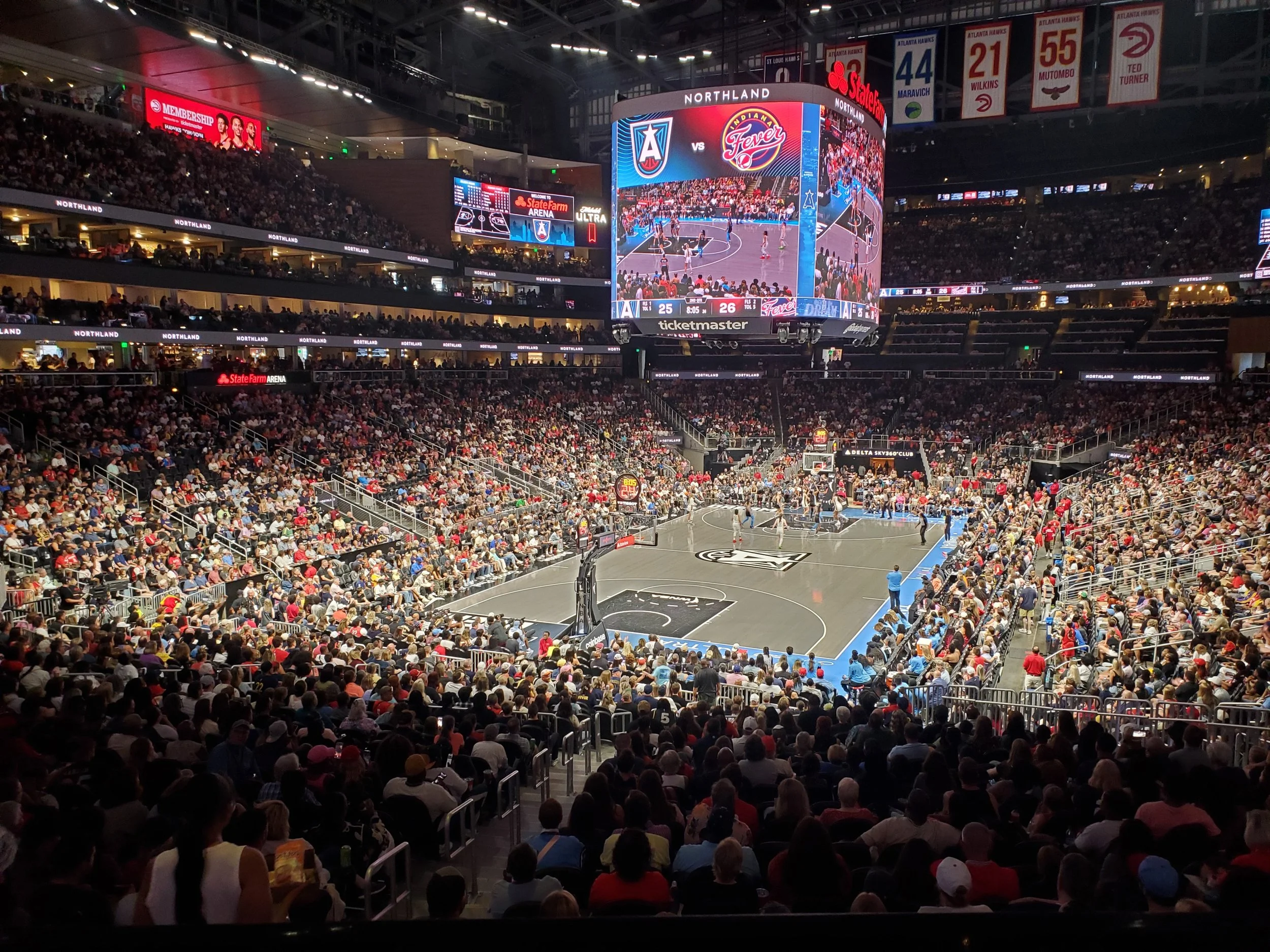
Atlanta's State Farm Arena (close to a full house) hosting Fever at Dream in August 2026.
You’ve Come a Long Way!!
September 16, 2026
In this article, a brief examination of the WNBA past, present and future will be presented. Topics covered will be where it came from, happenings this year and thoughts on where it appears to be going. To newcomers, some of this may be new while to veteran followers of the league much will probably not be surprising.
But first…
Congratulations to the USA National Team for continuing its world championship steak (five in a row) in defeating a strong French team (that led by two at half) in the recent FIBA World Cup final. I found the almost endless media and online criticism of the USA coaches, particularly Head Coach Kara Lawson, and Sue Bird, Managing Director of the USA Basketball Women’s National Team, to be entirely unfounded and at times close to nonsense and/or internet click bait.
Playing in a FIBA World Cup or Olympics is just different than the WNBA. New players (even the most talented) often need one rotation cycle to adjust to the mental pressure and the usually more physical style of play at the level. I would hope critics would be silent for now but somehow doubt it!!
Back to the ‘W!’
The WNBA past made simple
A promising start
The WNBA began play in June of 1997 with eight teams. The Houston Comets won the first of their four successive championships under Van Chancellor. The league expanded several times in its early years, maintaining 16 teams through its 2002 season.
The bloom is off the rose
As the new century began, one could see not all franchises were thriving as to attendance. Patience was urged and the NBA was covering most if not all financial losses. After the 2002 season, the Miami and Portland (re-born in 2026) teams folded. The league saw the number of teams fluctuate between 13 and 14 over the next few years with a few franchises folding while others were re-located or sold. Starting in 2010, the league settled on a twelve-team structure although the locations changed some. The league remained at a twelve-franchise level until the expansion in 2025.
After initial years of enthusiasm, it became clear to WNBA observers that owning a WNBA franchise was either a labor of love or a tax write-off for roughly half the franchises. When NBA leadership decided to let the ‘W’ financially swim more on its own, franchise hand-back (most embarrassing being four-time champion Houston in 2008), the above-mentioned franchise movement and contraction were set into motion.
Start of stability
Starting in 2009, corporate uniform sponsors started to appear on the scene infusing cash into maybe half the franchises. Still, things looked bleak as for long term survival of the league as it moved into the second decade of the 21st century. Sometime after 2010, I amongst others predicted the league stood a good chance of folding by 2015. So, what happened? ESPN re-negotiated a deal reportedly worth $12,000,000 in 2013. The deal increased in value a few years later and when combined with other sponsorship, stability came to the league.
So when did the WNBA really start to take off?
As an observer of the league and one who wrote on it for years, I saw no significant penetration into the mainstream of the American sports until 2020. That was the “Wubble” season when all games were played at IMG Academy in Bradenton, Florida. With in-person attendance shut down in response to Covid-19 pandemic, it appears more sports fans, trapped into watching sports at home, suddenly found WNBA play appealing. The mainstream sports media started paying more attention to it and this trend continued as in-person attendance returned in 2021 forward. As an example of the growth, in February 2023, the Seattle Storm (which the owners bought in 2008 for $10 million), reached a record $151 million value following a minority stake sale.
The Clarkees cometh
An explosion in WNBA-interest occurred in 2024 with the arrival of Caitlin Clark into the league and her legion of fans (I call them Clarkees.) brought over from college ball. I disagree with those who say Clark saved the league (as noted above, things started to improve financially to a more satisfactory level a decade earlier). Still, Clark’s entry brought media and fan interest never previously seen in WNBA history.
New CBA and media rights deal
The new CBA and media rights deal signed for the 2026 season has seen top player salaries go from close to $250,000 to a current annual maximum of $1.4 million dollars. Where in prior decades, one was looking at a WNBA game of the week, in 2026, games are on almost nightly. On one Sunday, there were games on ABC, NBC and ESPN at different time slots. Everyone wants a piece of the ‘W’ action with games this season also on CBS, USA Network and ION plus Amazon Prime (and occasionally NBA TV).
Successful expansion
The league has successfully expanded to fifteen teams as of 2026 with three more to be added by 2030, all with NBA ownership. The Golden State Valkyries was purchased in 2023 for $50 million and is now worth $1 billion. Besides playing to large home crowds, the team is in second place as of the World Cup break at the end of August. While neither the re-born Portland Fire nor the Toronto Tempo will make the playoffs this year, both appear to be drawing well and play entertaining basketball. A combination of infusion of foreign players plus an evolving style of play, which emphasizes more offense, has offset the potential dilution of talent per team.
Houston sale tells it all
After this season, the Connecticut Sun franchise will move to Houston with the Houston Comets (folded after the 2008 season when a new owner could not be found) will be re-born in 2027. The team will operate under the same ownership as the Houston Rockets. The sale price was reported as $300 million! Note franchises in 1997 were advertised at a price level of $10 million.
Below is a perspective on leaders for a number of regular season league awards prior to the resumption of play on September 17 with all stats just through August:
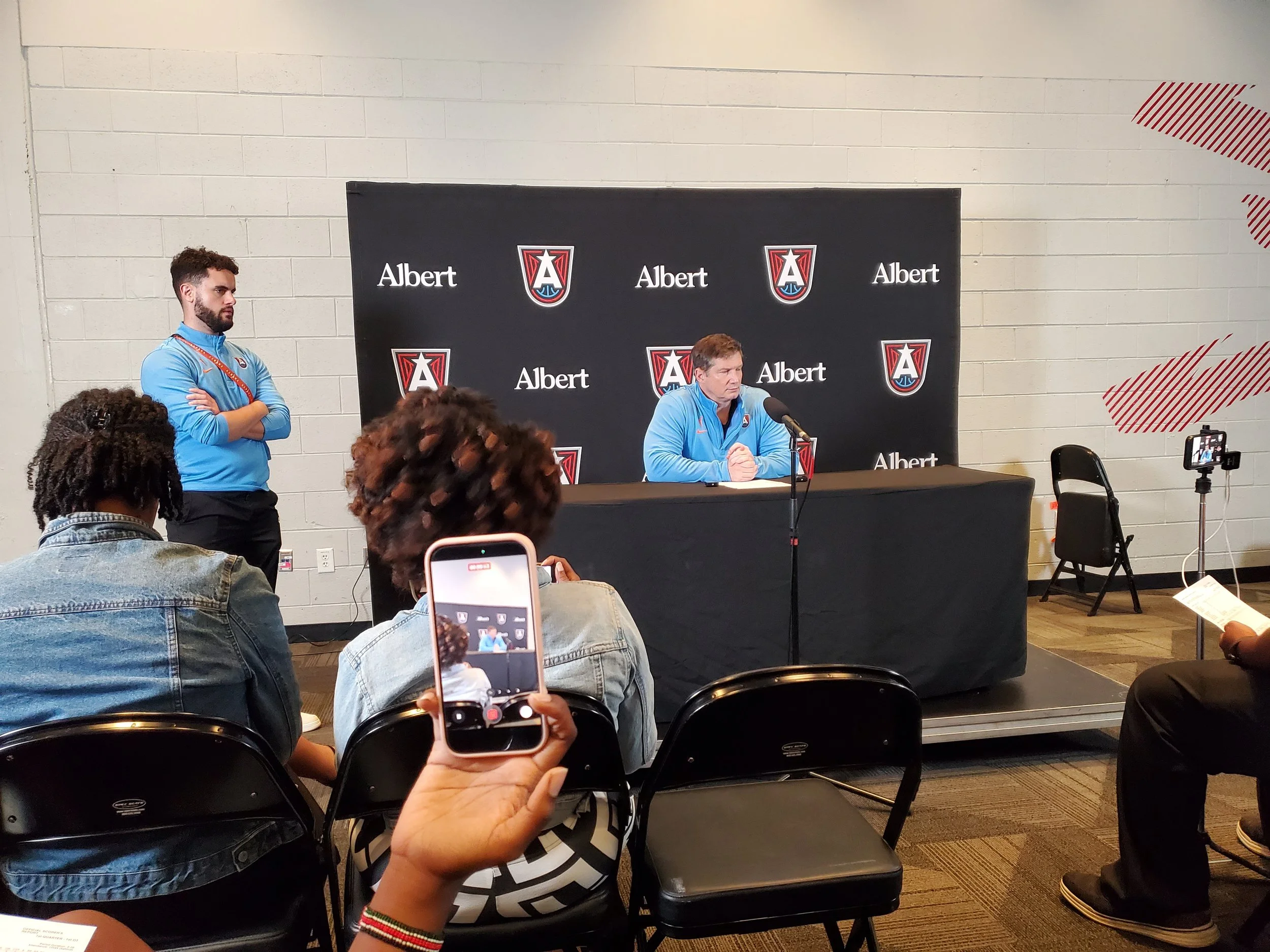
Atlanta Coach Karl Smesko fielding questions at a recent post-game.
WNBA MVP: A’ja Wilson – the Aces center continues to age like fine wine. As of the World Cup break, she was averaging 26.0 ppg, 9.4 rpg, 3.2 apg, 2.0 bpg, shooting 52.3% from the field. This would be a record fifth WNBA MVP. Hopefully, the nagging injuries, for which she skipped USA’s participation in the just completed FIBA World Cup, will be helped thanks to this lengthy break.
Other contestants would include the Lynx’s Olivia Miles (lock for rookie of the year) who posted 19.7 ppg and 6.0 apg shooting 49.5% from the field and 39.6% from behind the arc with assist to turnover ratio of 6.0/3.1 as of August 31.
If you could give a ‘combined entry,’ Indiana’s Caitlin Clark (22.5 ppg, 8.4 apg on 45.6% from the field and 37.3 % from behind the arc) and Kelsey Mitchel (25.0 ppg, 2.8 apg on 51.3% from the field and 45.5 % from behind the arc) might be the winner. While Clark is more creative (does turn the ball over more) for others and the better rebounder (3.9 to 1.7 rpg), Mitchell is considered to be the much stronger defender.
Rookie of the Year: Olivia Miles (#2 pick). This race is over and probably has been for some time. The interesting thing is that what Miles did as a WNBA rookie (see stats above) exceeded her college best. In 2026, there was not a media consensus for the #1 pick as say when Caitlin Clark was drafted in 2024.
Azzi Fudd (#1 pick) of Dallas had a solid year (13.1 ppg shooting 45.6% from the field and 39.7% from behind the arc) for 30 games until a knee injury put her out for the remainder of the season).
Seattle’s Flau’jae Johnson (#8 pick) is quietly averaging 14.1 ppg on 39.8% from the field on a poorly performing team.
Undrafted Sydney Taylor of Chicago has clearly been the surprise amongst first year players. She is averaging 13.8 ppg on 43.5% from the field. Taylor spent her last college year at Louisville and then spent two seasons in Europe (Poland and Lithuania) working to get better. Out of high school was considered to be a good high school player in New York but hardly a national name. She spent four college seasons at UMASS Amherst before finishing a fifth year at Louisville averaging 10.8 points per game.
In Seattle, #3 pick Awa Fam (out of Spain) has shown signs of brilliance but is still a work in progress averaging 10.3 ppg on 45.1% from the field plus 5.7 rpg. At age 20, this athletic post still has more upside.
Washington’s Lauren Betts (picked fourth) was the hero of UCLA’s championship run. However, there were questions as to how her speed and quickness would translate to the ‘W’ level. Playing only 17.1 minutes per game, she is averaging 6.4 ppg on a respectable 54.9% FG and 4.4 rpg in a backup role. Given this, the jury is still out on Betts. Will she be better long term than Atlanta’s post Madina Okot (pick #13) who is averaging 5.4 ppg on 57.6% FG in just 9.2 minutes per game?
Coach of the Year: Natalie Nakase. The Golden State Coach worked close to a miracle taking an expansion team into the playoffs in the franchise’s first year. Having won WNBA Coach of the Year in 2025, she has exceeded that in year two, likely finishing as a top four seed.
Cheryl Reeve of Minnesota may well get this award as the team is pointed toward a first- place finish but Minnesota’s success is less unexpected to me.
Most Improved Player: Jessica Shepard. In her sixth year, the Dallas forward has almost doubled her production to 14.4 ppg from a career average of 8.6 ppg. The has also improved her rebounding to an average of 11.1 from a career average of 7.6 ppg. For her play this year, Shepard received WNBA all-star honors.
One could also argue for Toronto’s Marina Mabry who scoring average as of the end of August is 20.8 ppg versus 14.4 ppg last year but rebounding and assists are down slightly from last year. For her play this year, Mabry also received WNBA all-star honors.
In her fifth year with the Mystics, Shakira Austin is having her best year raising her scoring from 12.7 ppg last year to 16.8 ppg this season with rebounding from 6.4 rpg last year to 9.4 ppg this year.
Golden State’s Kaitlyn Chen is averaging 6.8 ppg versus last season’s 2.9 ppg. Her shooting percentage has risen from 38.0% to 53.2% this year.
Portland’s Carla Leite has numbers that have jumped dramatically from her rookie season scoring 7.2 ppg to 15.9 ppg this season shooting 45.9% from the field compared to her rookie season’s 38.7%. Assisting is also up at 6.3 apg compared to 2.0 apg last year.
Given that I view the award as more of an improvement of a veteran than rookie progression (Chen and Leite) from year one to year two, I lean toward Shepard but Mabry and Austin would be two others I would have to consider strongly.
Defensive Player of the Year: This is not an award I usually take a position on, but I would have to look at Gabby Williams of Golden State besides perennial candidate A’ja Wilson.
Sixth Player of the Year is another that I generally take no position on. The talk online has Janelle Salaun of Golden State as the favorite. The reason this does not excite me is that you get eliminated by being a starter.
A brief look at the eight teams which are going to be in the 2026 playoffs:
Before getting into each team’s chances, let me say if this year’s playoffs were run on a computer 100 times, I suspect more than two teams would win at least once. It has been a year where a fan needs to be ready for the unexpected game to game and within games as several teams have established 20 point leads only to lose the game!
Match-ups will be important and even with just four games to go, the exact pairings for round 1 are not yet clear. With four games left to play, fourth place through eighth place was only separated by two losses (14 vs 16 losses over 40 games)! The drop from eight to nineth was very sharp (16 versus 24 losses with four games left).
The standings (with a discussion for playoff-bound teams) before resuming play on September 17:
Lynx – Minnesota has been one of the top teams in the league for years led by a 4-time WNBA championship coach Cheryl Reeve since 2010 (several lifetimes for many coaching stints). The Lynx play smart team basketball spearheaded by a veteran all-star Napheesa Collier and star rookie Olivia Miles. The one kink in the armor could be the lack of size on the interior. Going into the playoffs, the favorite but by no means a ‘lock’ to win the title.
Valkyries – What Golden State has accomplished in its first two years of existence is indeed special emphasizing strong defense making the playoffs in year 1 and vying for a top four finish in year two. This was accomplished by gluing together a roster of expansion castoffs, rookies and a few free agents with an emphasis on foreign players (about half the roster are eligible to play for countries besides the USA). The addition of Gabby Willians via trade before this season may been the key move in putting together a roster of strong defenders who have collectively improved offensively under Coach Natalie Nakase (2025 WNBA Coach of the Year). Not having one of the leagues very top players, one might expect this team to eventually slide down the standings, but it has not.
Aces – Las Vegas is one team that I diagnosed correctly as to my thinking pre-season. The core of the team is not young and depth is not great. There would be days when the team just “did not have it,” sort of like a distance runner falling pack in the pack preparing a late charge to repeat as champions. The season ending injury to forward Na’Lyssa Smith hurts the team’s chances though having A’ja Wilson, Chelsea Gray and Jackie Young along with veteran Coach Beckie Hammon still makes them contenders!
Dream – Atlanta (the team nearest where I live) has a blue-collar lunch bucket mentality. The team has a cast of solid quality WNBA players but without the aura of any media darlings. The team emphasizes athletic physical play capable of beating any team in the league. Additions to the team have welded a solid contender by bringing in rebounding machine Angel Reese, finding value in drafting valuable post Madina Okot with pick #13 and Isobel Borlase with pick #20 this spring and trading for veteran forward DeWanna Bonner in August. As coach Karl Smesko said in an August press conference “Our basketball team is as good as any [in the WNBA]. Can we be consistent for all four quarters? I think so.” The playoffs will tell us if he was right.
Fever – Indiana is the unquestioned favorite team of the league media with every game televised on some outlet and the team whose games are most watched. Caitlin Clark continues to be the most financially impactful player in the league and combining with Kelsey Mitchell, represent one of the greatest backcourts in WNBA history for a single season. Although improved defensively, Indiana’s best defense is outscoring its opponents racing toward 100 points. And finally, let me say no coach has been subjected to more unfounded online verbal abuse than Stephanie White, often targeted by the Clarkees (fiercely loyal fans of Caitlin Clark). Does anyone remember the playoff run the Fever made last year with a very depleted roster?!
Liberty – New York has been the biggest disappointment as to meeting pre-season expectations of a team stacked with WNBA stars led by FIBA World Cup MVP Breanna Stewart and Jonquel Jones to name just two. Granted the team has had its share of injuries, but for much of the year cohesion was not the best and at times, its perimeter defense has simply not been one that will win a championship. Over the last 10 games the team has gone 7-3 and shows signs of getting it together. Given the league’s most talented roster (if not close to it!), the Liberty cannot be counted out until eliminated.
Mystics - Washington had questions pertaining to point guard play prior to the season. Those questions remain as Georgia Amoore (drafted at #6) is at best a work in progress. Using star wing Sonia Citron at point has worked at times and might be more heavily employed in the playoffs. The duo of Shakira Austin and Kiki Iriafen is one of the best interiors in the league, not allowing Lauren Betts (drafted #4) more than a backup role. Guard play being so critical, it is hard to see this team making a deep run without a marked upgrade in the playoffs.
Wings – Dallas has had bit of an up and down year (5-5 before the World Cup break) recently losing #1 pick Azzi Fudd for the season. Going big with Awak Kuier on the perimeter has helped them overcome the loss. My feeling about this team prior to the year was that they still needed more interior punch to win a league title. If both Paige Bueckers (limited with warmup injury in USA – France final) and Arike Ogunbowale get on a role in the playoffs, they might advance at least beyond round one (a tricking best of three).
Finally, who is minding the store as to monitoring the development of young talent nationally?
Answer: No one!
The WNBA is now at 15 teams headed to 18 as of 2030. While expansion could be viewed as dilution of individual talent, the interest is currently at an all-time high as of 2026. At some point, the continued adding of more teams may create a product that becomes less acceptable with a decrease in fan interest.
Currently, the WNBA leadership has a “hands off” policy toward high school player development. While some players get tremendous guidance as to their development from middle school through high school, for others it is ‘hit or miss’ as to the direction progression of a players will take. The NCAA is too busy fighting for its own existence. USA Basketball has a very limited staff and is primarily concerned with stocking a few teams for international play. This leaves the WNBA as the one force that could somehow provide (and I am not trying to say just how) overwatch so that potential quality talent does not fall by the wayside never reaching full potential.
As someone said to me recently, the WNBA leadership is like a person just concerned with the toothpaste coming out of the very tip of the tube assuming more toothpaste (WNBA quality players) will continue to be cranked out in the years to come. With the pool of quality young female athletes less than its male counterpart and the number options for those athletes to center their interest on, there is no guarantee that the flow of high-quality basketball talent will be as strong in depth going forward as it has in the past.
New ownership groups are sinking hundreds of millions of dollars into new WNBA franchises. With the likely financial desire to grow the WNBA in terms of number of franchises, the league needs to be careful not to outrun the talent. Foreign players have really helped make the expansion to 15 franchises successful. Whether foreign-based players can be the primary source to fuel further expansion is debatable.
Bottom-line: Currently, the WNBA is assuming the talent flow will be just fine for an enlarging league. At this point, I am not recommending any specifics but just saying the league executives need to seriously start to look at monitoring young domestic talent as to its proper development.